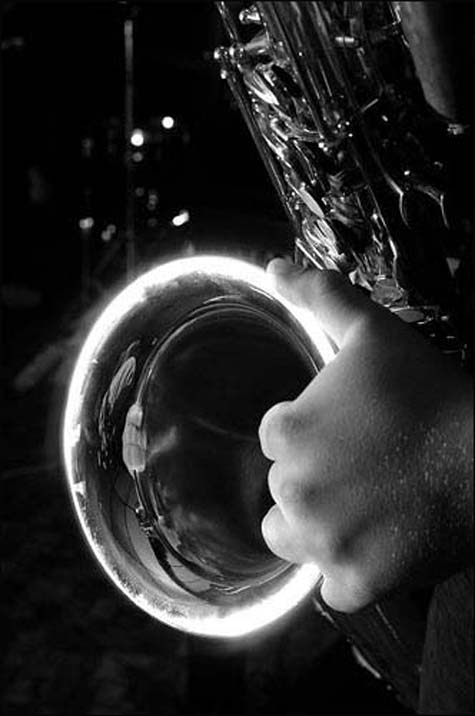
Photo Credit: Peter Tobia
(For more of Peter Tobia’s images of Natalie’s Lounge, visit: http://www.petertobiaphotographer.com/#/natalies-jazz-lounge/77)
Excerpts from “At Natalie’s”
Natalie’s was transformed by the meager daylight that crept in during the late morning hours. I opened the door, it shut behind me, and immediately the quiet, unassuming bar became a surreal universe, suspended in time, alone and separate from the tiny corner of West Philadelphia in which it had survived for so long.
The flickering lights overhead did little to brighten its tunnel of a room, all quiet except for the television noise, the air conditioning hum, the occasional word spoken by one listless patron to another as they sat on their bar stools and hid from the day.
The booths across from the bar sat vacant. But the pictures stood out on the walls. These faded black and white pictures, just all over the place – on the cheap wood paneling and behind the barren stage. Some of them autographed. While the bartender stood mesmerized by the fuzzy television screen and the few patrons at the bar played out their somnambulistic ritual, there wasn’t much to do but watch water droplets descend down the sides of beer bottles or stare at the walls—the pictures on them.
A wasp-waisted Sarah Vaughan, shoulders pulled up in a half-shrug, eyebrows raised above questioning eyes, in a white dress that nearly hangs off her. Her hands dangle by her side and she holds her mouth open – not too wide, but just so. Singing soft, the whole image so full of expression that the silence of it seems unnatural.
A very young John Coltrane, sax tied round his neck, eyes turned down to the floor, brow furrowed. One index finger to his mouth in concentration, the other hand on the back of his neck, so that the elbow strikes up at an odd angle in the air over his head.
Dizzy Gillespie, all glasses and cheeks and horn, his lips pulled back over his teeth and his cheeks puffed out—the force of the coming note so apparent in the round, taught skin of his face. The light-reflecting trumpet. Eyes staring off into no place.
That beautiful shot of Billy Holiday in which the heroin hides beneath a polished veneer. Head thrown back and mouth wide open. The glint from the camera’s flash on her shining lips. Her hair pulled back perfect and smooth. Sparkling earrings. But the whole image itself—the arched neck and the stretched, protruding muscles, her mouth like a scream and her eyes closed in relief—the whole thing so full of pain and sorrow and joy and every possible emotion all at once.
The pictures were more vibrant that the room that held them. And, if I stared at one long enough, I expected its subject to break pose. In that slow-motion space, the anticipation that those old instruments might burst into music all at once, that the ghosts of the musicians holding them might alight from the walls, flock to the stage and envelop the room in jazz, was intensely real.
Billy, after all, could not belt out that single note for eternity.
Scores of these pictures lined the walls—photos of recognizable faces, photos of obscure, local musicians. They stared back at me and clutched their silent instruments. I wondered how many of them were long dead.
Natalie’s was transformed in the daylight. As though there were no street outside, no cars, no rain pouring down from the gutters, no West Philadelphia. As though there might just be this one abandoned room and this one room might always be this dark and quiet and still. As though the sign on the wall, between the fading photos, might be some empty invitation left over from its long-gone past:
Jam Sessions. Saturdays. 4 p.m. to 8 p.m. Bring your axe.
•
I found solace in my late night walks to Natalie’s Lounge, a little jazz bar, a neighborhood dive, on the edge of campus. This was the fall of my senior year at Penn. I’d go about once, maybe twice a week. Almost always on Saturdays for the jam sessions, but on weeknights if I wanted the bar empty, if I didn’t want to run into Lucky Thompson or Tony Peebles or anyone who knew that I was writing about them and didn’t know that I’d already finished the piece and that it wasn’t very good. I’d been a spy, masked as a journalist, with a notepad and tape recorder, inauthentic, pretending my way through.
I knew enough about music to fake my way through conversations, through interviews. I’d played classical flute for seventeen years and in numerous orchestras. In my early years, more than one conductor had described my musical ability as exceptional, though I never thought there was any truth to the claim. I had a good ear, good tone. I could hit the high notes and play the scales. I could read the music like a native language. But then there was jazz.
I knew a few names and the instruments they played, their signature styles. I knew distinct voices, and how those voices sang. I knew certain favorite melodies by heart. But I didn’t know the deep history of the music and I couldn’t claim any real part of it as my own. I couldn’t pick up my flute and improvise, couldn’t make my flute a bird-like voice, full of word-sounds and cries and human emotion. And when I went to Natalie’s, for the jam sessions, there was always that feeling: even on the inside, I was an outsider.
I lost track of my agenda at Natalie’s after my first few months and I went without any real purpose. My deep secret was that I knew barely anything about jazz and, worse still, that I didn’t really, truly care, so long as I could listen and hide away within it for a while.
•
This is the corner of 40th and Market:
SEPTA stop on the corner, litter in the street. Everything covered in its coat of city grime. A few kids who loiter in sweat suits, who look suspicious and may very well be, given the neighborhood and its history of socioeconomic and racial upheaval. This is the corner they told you marked the boundary, when you first began your time at your overly privileged Ivy League school. This was where you, little naive white girl, ought not go. But here there are only a couple of pawn shops, a few bodegas. Folks, mostly black, mostly older, mostly looking tired and waiting for the bus to take them home to theirs. Natalie’s Lounge, marked by an old neon sign that looks like a remnant from the fifties. Liquor store down the street. Beige housing projects that rise up like rock formations in the background. A rumored whorehouse—open when the red light’s on—even though no one can pinpoint its exact location. It always felt perfectly safe to me, even though it wasn’t always.
Some things change between night and day. The curtain of night descends slow, streetlights flicker and shadows cover certain, specific doorways. The crowd sounds that blend together and fill the sidewalk during the day fade into far-away laughter down the street or into the tense and muffled argument of two women who hurry past. Signs in shop windows change from “Open” to “Closed” and keys lock one, two, three, four locks. Metal barriers fall over storefronts like cages. Nearby, up the street a ways, or on the corner: blue, red, and white lights flash, always. Often, sirens sound. When the night becomes total, the corner does become sinister and the change is a feeling I get at the pit of my stomach. And the feeling is not because of the crowd, so much as it’s because of the ever-presence of the police, always waiting.
This is the corner of 40th and Market, where the man on the corner said to me beneath streetlights, in the cold air, and above the rush and swish of tires:
“Hey, hey. Wait up.”
I glanced back at him, and the boy-men huddled behind him on the street corner. I tried to kept my eyes down, but saw, in my peripheral vision, his feet running towards me. I kept walking across the street, because that’s the only thing to do when you are walking alone at night, when you are young and female and vulnerable, in West Philly. When you also feel young and female and vulnerable even in within the grounds of your school. Someone called:
“Man, don’t bother. Come back,” which is when the man came close and whispered:
“Do you smoke? Do you smoke weed?”
It came out in a sort of hiss. He tried to keep pace.
“How about coke? I’ve got coke.”
I was tempted to tell him to fuck off, which I didn’t. I shook my head, said no, kept on walking.
But this was a normal encounter, nothing out of place. Better than most of what I heard at the frat parties I should never have attended. Every night that I went to Natalie’s Lounge, I crossed Market Street, on 40th. Despite my knowledge that this corner was allegedly unsafe – knowledge garnered from the warnings and reprimands of friends and authority figures – I just got used to whistles, the sound of far away gunfire, police sirens and drug dealers, after awhile. The real life noise became comforting. After all, this wasn’t North Philly, or the South Side of Chicago, where my Daddy grew up way back when there were Serbian steel-working neighborhoods across those tracks. This was not Cabrini-Green, and even if it were, I suspect I would have gone. After all, the only reason anyone at Penn really thought this corner was dangerous was because it was less white. And when I moved to Tucson, a year later, the utter silence of the city at night terrified me.
On my way back from Natalie’s, back towards campus, on any given night:
It was like I’d left some secret society that no one knew about, which wasn’t far from the truth. Natalie’s, for all its history, is probably the best jazz joint in all of Philadelphia. It’s also the least well known, except by real musicians. Once I hit Pine Street — that invisible line that divided campus and “the neighborhood” — walking West, the crowd thickened. In my wake, metal bars crossed the facades of mini-marts and ethnic clothing stores of all sorts — closed for the night. Behind me, the homeless sat on stoops and smoked or didn’t, asked for money or didn’t. Once I reached Walnut Street, bright lights illuminated the sidewalk, and on the other side of the street, sprinklers showered lush grass behind a wrought iron fence. The constant stream of customers emerged, bags in hand, from Fresh Grocer, which never closed. Then, I passed the drunken students at Smokey Joe’s and the loud and tireless bar music, usually Bon Jovi and Springsteen. Another version of me went there, too, most Wednesdays for years, and did shots until I couldn’t see straight and hated myself some for being so fucking mundane.
This all looked—felt—different in the mornings and afternoons.
•
It was Ryan Johnson who first wanted to go Natalie’s, but he never came along in the months that I sought refuge within its world. It was Ryan who told me about Natalie’s, after his History of Jazz class, back in my junior year, when we used to listen to jazz for hours in his bedroom in the Spruce Street apartment that was as home-like to me as my own.
He spoke fluent jazz and that was one reason that I found comfort under his protective wing during the years we spent together with the rest of our small, makeshift family at Penn. He taught me the way a father teaches his daughter her first words.
He’d play the music on his stereo and, as it danced into my ears, make me guess at its creators. I guessed wrong until I started guessing right. He’d hold his trumpet and never, ever play it, no matter how often I asked. He’d move his fingers over the keys, shake his floppy brown hair around his eyes, gnaw at the skin around his thumbnails. He’d light a cigarette every few minutes—a habit I shared—until we filled the room with smoke. I pretended to be oblivious to the fact that the scene we made seemed like some cliché from a Kerouac novel, minus Benzedrine and Tokay. It was all a sad, sad stereotype. Because Jazz did not, never will, belong to us.
But it was Ryan who brought up Natalie’s, while Kari was there one day, sprawled across his bed with sleepy eyes, red hair and her far away look. He said something about “that little bar on the corner, that rundown looking thing,” which I must have passed twenty times and never actually seen.
“It’s got the best jazz in Philly, apparently,” he probably said – something a little nonchalant and skeptical like that. I imagine he blew smoke out of his nostrils as he said it. “Or so says Dr. Ramsey.”
Dr. Ramsey was his professor, in the jazz class, who Ryan described fairly often as a “pompous ass who thinks he’s God” or some variation on that theme. The names began after Ryan and Kari attended a concert of Ramsey’s for extra credit. Apparently, Ramsey walked into the room and, when his students did not automatically applaud him with standing ovation, he demanded enthusiasm, walked out and re-entered. At least, that’s the story. On the other hand, Ryan never once denied that the man knew his shit when it came to jazz. And as it turned out, that was quite far from the truth. Dr. Ramsey was as demanding as every music teacher, teaching jazz to us, ought to have been. He was intimidating, and he deserved to be. The man knew his shit.
Ramsey mentioned Natalie’s to his students and so Ryan mentioned it to me. We made our plans to go, but I knew when we made them that we would never really keep them. Afterwards, it took me months, maybe a year, to find my way there.
•
I met Dr. Ramsey only once, after I’d decided to write the piece. He went to Natalie’s on Saturdays, for the jam sessions, though I never saw him there. Played piano, though I never heard him play. Spoke like an academic, laughed rarely and, when he did, the laughs made me jump with the sudden strength of them. His office in Penn’s music department was clean – too clean – and filled with books about music, and rows upon rows of albums. When I walked in, he said:
“How long is this going to take?”
I wanted to know about the place—this little jazz dive that had, supposedly, been around forever, this place that people mentioned with devout reverence, if they’d been there, if they knew about it. And I thought, it could take forever, but said:
“Ten, fifteen minutes.”
It seemed clear that did not want to explain this music, or this culture, to me.
But I also know that it is not the goal any professor at any major educational institution to teach. Teaching is what they do to be allowed to research, to experience, to publish, to envelop themselves in their academic obsession. I know this from my Daddy, and from my Mama, and the years they spent in their nebulous academic cloud. I know this from everything I heard at home always. You must love a subject deeply to let it own you and obsess you. And Dr. Ramsey’s obsession is Jazz.
Dr. Ramsey did not want me there, in his space, in his world. But once he began to speak about it, he was somehow unable to stop. At the end of our interview, when I shut the tape recorder off, I asked him if he planned to play at Natalie’s anytime soon. He pushed his glasses up on his nose and dropped his eyes to the desk. His answer came hushed and in the kind of sorrowful tone that belongs only to regret.
“Oh, I don’t know. When I’m invited. You know, I used to go through there and sit in and do a lot more. But things. Things have been very busy for me recently…”
We shook hands and I left, with a page of notes and a tape, the knowledge that Dr. Ramsey had said all he would ever say to me, except as a student, some small idea of Natalie’s place in the Philadelphia jazz scene, and a phone number for Lucky Thompson.
•
This was not the first time I’d been to Natalie’s, but it was the first time I’d been in the morning. The first time I’d ever been to a bar in Philadelphia in the morning, or anywhere that I can recall. Outside, the stairs that lead underground to the Market-Frankfort El were empty, no one stood outside Natalie’s heavy, closed door, its windowless façade. The sign above the door, unlit during the day, seemed decades old even at night, with its missing bulbs. In the day, the sunlight faded it further. If I hadn’t known any better I’d have thought the room behind the door was abandoned and I would have had to dare myself to pull the handle.
My eyes adjusted from the glare outside to the dim room, the old-style jukebox to my right, the booths and their cracked vinyl behind the music maker that rarely played. When it did play it, it played on nights when a young, sometimes rough, crowd arrived. The crowd was mostly black, and mostly from West Philly, and mostly just having fun. But the younger members of that crowd also wore the “uniform”: white tank top, baggy jean shorts in the summer, baggy sweats in the winter, so that everyone became anonymous, so that anyone could be anybody or nobody at all, especially when it came to witness identifications. I had watched boys in that uniform beat up innocent people in South Philly, and I had watched boys in that uniform hold a gun to my ex-boyfriends head. And I still thought that uniform was probably a good idea for all those boys that didn’t do those things, and even maybe for those that did. So, I went on those nights too, when there was no jazz, when I knew no one there. I went and watched the new generation in the old head bar as they listened to hip-hop and drank and, for the large part, left me alone to drink my own drink and enjoy my own quiet in the noise.
But, I really went because I had to capture everything, had to write it all—though I never did, not really. I went, too, because no one cared that I was there. No one gave one tiny iota of a shit why some college white girl, who kept her head down next to a Johnny Walker neat, or talked to the bartender – who she seemed to know – was sitting at Natalie’s.
In the morning, everything was different and desperately quiet. The kind of quiet that gives a place a tired, groggy feel, like everyone in it’s been up all night and drinking past sunrise. The wooden bar bore a small host of elbows and drinks as its patrons sipped beers, drew puffs from occasional cigarettes or cheap, pungent cigars. We sat together in these doldrums, broke them with an occasional comment about the Jerry Springer episode that played on the television set at the corner of the bar and rambled on and on about so-and-so dating so-and-so’s cousin’s ex-girlfriend’s baby-mama.
I stared at my hands and tried to push the results of the previous night’s presidential election from my mind – an attempt that made the topic all the more prominent and obnoxious. I lit a cigarette and watched as the bartender sliced lemons, methodically, in tiny, even pieces, her poorly-dyed blonde head bent over in concentration. Rhythmic, even strokes. She picked up the slices and placed them next to the maraschino cherries in a plastic bin. Someone got up and put a quarter in the jukebox.
I ran my fingers over the tape recorder in my purse, my notebook, my pen. I pondered ordering a glass of wine, a Corona. I waited for Lucky.
I was twenty minutes early for our interview – a product of the fact that I was nervous as hell. A product of my fear that he’d first, wonder who the hell I was; second, determine that I knew nothing about jazz; third, see right through me. There was no equilibrium here. Lucky, Natalie’s music director, was legendary around Philly. He’d played with Patti LaBelle, Nina Simone, Val-Ray, Big Mamma Thornton. I was a dilettante in my best light.
The bartender looked up from her lemon-cutting daze:
“You sure you don’t want something else to drink, honey?”
“This is fine, thanks.” My fingers hugged the glass.
“Lucky’ll be in soon,” she told me. Her eyes were an apology, as though she was responsible for his absence, or pitied me for my lonely place at the bar. She handed a chilled glass and a Bud Light to the women who sat next to me, then returned to the lemons, the endless lemons. The Bud Light woman had been chain-smoking her pack of Marlboros and when she exhaled, she sighed out her smoke in a tragic way. She sipped at the froth from her glass. Her skin was dead pale – pancake painted makeup pale – and her eyes smeared and over-dark, like she’d been made up at the funeral home by a rookie. She’d been mute since my arrival, which was just as well since I didn’t want to talk to her or most anyone. She kept silent with a vacant stare, pupils pointed at the huge metal cooler behind the bar like she could see right through it and maybe she could. Its sliding doors didn’t close properly and one of the glass panes had crack, though someone had sealed the wound with duct tape.
The jukebox fell silent and the man to my right, Phillies cap pulled down over his forehead, track suit tight across his porcine gut, who had slurred along with gusto, collected a few quarters from the bar and moved towards the machine.
“Did you play that number yet? From yesterday?” The woman asked, as he returned to his seat. I nearly jumped at the sound of her voice next to me.
“Hunh?”
“The number from yesterday.”
“Yeah.”
The Bud Light woman turned to Jerry Springer. I took out my pack of Camel Lights, brought one to my lips, lit it, then let some time slip by me.
•
This is how I learned to play the flute when I was four:
I placed a grain of rice on the very tip of my tongue and kept the tip of my tongue lightly between my lips. Then, I spit the rice gently and without saliva, spit it gracefully and without a spit sound, but with a sharp quick stream of air. Spitting rice staccato. Twenty in a row and just keep going. Every day. Once grasshopper has mastered spitting rice, grasshopper may blow on bottles.
It took me one month to spit rice in a manner deemed acceptable by my teacher. At the end of each lesson, a floor littered with grains of rice. Then, glass bottles against my lips and the sound of air whooshing over their mouths for what seemed forever until – at last – a deep note, a note like a boat’s horn in the fog. Up and down the stairs with the bottle and deep mournful bottle notes, outside my mother’s door. Whole breaths spent on the longest possible bottle note until I gasped for air. My mother confiscated the bottle after a week.
When I picked up the flute, I still could not play it. Once I could, weeks on each note, long notes and staccato. Eighth notes, quarter notes, half notes, whole notes. Crescendos, decrescendos. Sharps, flats. The C major scale. The awful high, high notes, held long. I learned never to tap my whole foot and only ever my big toe, to hold my elbows up and out and not down flat at my sides until my shoulders began to ache. To breathe from my diaphragm.
I once bit my first flute teacher on the hand so hard that I drew blood.
•
You know you love your music and the instrument you play to make it when you listen to it so often that you start falling asleep to the same piece of Bach every night, until you fall asleep whenever you hear it, always. Until it gets inside you like it makes the tears well up and the feelings come out and go. Until you can’t pay attention to anything else when you hear it. When its sighs and its shouts and its conversations eat up everything else in your heart and your stomach and your mouth. When everything you live exists in relation to the notes you play and every bar, every note, every move of your fingers are different comment in a way words just don’t work to say. When you think the worst thing you might ever do in your life was letting that instrument go for something you thought was important, but would never be what it was to you. When you look at your unplayed piece with its dents and disgrace and mourn for it. You know you love your music when you’ve let it go and it still leaves you wanting it every single moment of every day the way you want your long dead grandparents to hold you still when you feel lost.
•
When I was first flute and first piccolo in Penn’s orchestra my freshman year of college, I only once told anyone that I was “playing a concert.” I never practiced in my dorm room and never once told anyone where I went when I was going to practice. I kept my love all to myself and deep inside. I felt every note so strong that I played until I had no idea what time it was. But I stopped playing by the end of that year. There was too much else and too little time. I was too afraid of being seen and heard. Only years later, I understood that I had amputated an unseen limb.
•
Lucky Thompson, when he was five years old, lived in South Philly which is about when he started playing on his mother’s pots and pans. Maybe he was around four, even three, but it was somewhere in there. He was this chubby-cheeked, espresso-skinned rowdy little boy, who banged and clattered all day on the gleaming metal. He still looks like that, like a kid banging away when he plays: his limbs move manic, his head bops up and down with the beat, his whole body shakes. He kept the pots up for a long time. Got on his mother’s nerves too, until his father said, out of the blue one day:
“We gotta get that boy some drums.”
So, Lucky got to learning on the real thing. His father began to take him to a little place in South Philly, a place a lot like Natalie’s, to let him jam. Only thing was, Lucky was so short, he couldn’t reach the bass drum pedal. Only solution was to kick the bass drum with his foot, so everybody though that was a riot. His father would take him there. He was around eight and too young to be in bars, but his father would take him there, and they’d let him sit in and play, let him do a little drum solo and sometimes pay him a little.
•
“Are you married?” He was slurring, the old black man wearing the fedora and three piece suit. He leaned down over the table towards Jessica whose cheeks blushed against the pale of her Irish skin.
“No.” She replied. I glanced over at Mary Margaret who raised a thin eyebrow and smiled in her knowing way. Jessica was a dead-ringer for a young Geena Davis back then. This was not the first drunken bar proposal she’d received in our company.
“Would you like to be?” He asked and leaned in closer.
“Nope. Not really. Thanks though.” He stumbled away. I wished she had say yes.
This after he’d wandered over to the table, after he’d said, “I come here every night and I’ve never seen any of you.”
“That’s cause we’ve never come before,” I told him, which is when Mary Margaret lifted a bony arm in my direction and betrayed my secret:
“She’s writing a story about the place. She’s a reporter.”
And so this was when he suddenly seemed sober and he told me how his father used to play with Charlie Parker and did I know that Natalie’s was the oldest and longest running jazz bar in town and damned if the best musicians weren’t always here. His eyes fixed on Jess as he spoke, but their expression full of the deep kind of love that comes when one feels that a place belongs to them and they to it. His smile so earnest. I looked at the empty stage and wondered where the musicians were, if they were always here. Wondered if all those other old men strewn about the room in suits from a bygone era were the musicians, or if they just wanted to be. What memories they had from this small room that smelled like liquor and felt like electricity.
The speakers above the stage blasted bebop and this one couple on the dance floor, I thought their feet would fall off if they moved any faster. A blur of red pumps with two inch heels, the black silk dress a snake twisting around her body. The chain around her partner’s neck bounced up and down and sideways. Sweat ran down his cheeks. Her hair, half-grey, had fallen loose from its careful pins. The suit—he had to be boiling hot in that suit. They’d been going, non-stop, since we walked in twenty minutes before, maybe longer. They just kept bopping in the narrow aisle between the booths and the bar, her teeth bright white when she laughed, her eyes shining amidst their wrinkles. The grace of them.
Jess whispered:
“Don’t you wish you could fucking dance like that?”
After about ten minutes in Natalie’s, it became obvious that everyone knew each other, than everyone was a regular, and we were not. When we’d walked in, despite the music, despite the couple dancing and the chatter, a few heads had turned towards us and eyes had stared a second too long. I felt immediately out of place – like we had intruded on a well-kept secret. And it wasn’t because we were the only white kids there, or the only kids there at all, but because there was this atmosphere about the whole place, this family feeling—it was as though we’d burst into someone’s living room unannounced.
But we sat down in a booth and stayed quiet for awhile, just sipped our beers and watched the crowd. And it grew comfortable and easy then. I took notes. Mary Margaret snuggled up to the wall, knees drawn to her chest, feet on the vinyl. Jess began to talk about the previous night. We drifted into her story and forgot the space around us, which is when the man proposed to Jess while we sat at the booth, beneath the picture of Nat King Cole.
Afterward, I walked to the bar to get a whiskey and asked the bartender if she knew who owned the place, who I should talk to if I wanted to find out about its history.
“What do you want to know all that for?” she demanded. She was a large woman, maybe a few years younger than my Mama’s age, and clothed so that one couldn’t help but notice her breasts — tight leopard print shirt, cut down to there, her bra hanging out of it. Huge gold hoop earrings that stretched her earlobes with their weight. She was both gorgeous and terrifying.
“I’m writing a story about it.”
She told me to come back on Saturdays, when Lucky was around. But, when I asked her if I could have her name, the smile fell from her face sudden as a gunshot. She looked at me hard and mean.
“I don’t want my name in no paper. Don’t want to be involved.” She handed me my drink with warning in her eyes, then turned away. Funny thing about her—she’d never once tell me her name, no matter how many times I went to Natalie’s. But after I ordered that first Johnny Walker, she remembered my drink. I’d walk into the bar, sit down, and she’d slide one over to me before I had a chance to order. Every time. Sometimes she tried not to smile.
I slid back into our booth. I stopped listening to whatever is was my friends were saying. Just felt like watching instead. None of us ever got up to dance. I kept imagining the stage, whether I might ever have been good enough to stand up on it. Whether I ought to have learned brass instead of wind.
That was my first time at Natalie’s and the last time I took anyone with me.
•
Lucky learned from the old heads, the seasoned musicians, the ones who’d been playing long before he’d learned to kick a bass drum with his foot when he couldn’t reach the pedal. That was how it was. A generational thing—how the music kept on going.
He’d get up on stage and start playing.
The old musicians would pull him to the side, and they’d say:
Hey. Look. Play this. Do that. Don’t do too much of that.
And they were real critical. They’d let him know if he was playing too much, stepping on some guy’s solo. But they’d guide him too, always guide him in the right way.
That’s how you learn. You get on stage. You take the advice, you grow with it, or you close your ears and you don’t learn a thing.
It’s trial and error.
You have to be humble. You’ve got to have thick skin.
You’ve got to listen to what’s going on around you. You have to open your ears.
You’ve got to be at a certain level when you get up on stage, and if you’re not there, you go home and you practice like hell.
•
On Saturdays, I heard the jazz from across the street. Only on Saturdays. Any other day of the week and I’d never have guessed what went on behind that closed door. But on Saturdays, the whole corner became a jam session. The street outside its own jazz thing – the honk of a car, the flash of a street light from yellow to red, the drum beat from behind the bar’s façade – each movement an improvisation.
Inside, musicians filled the cramped stage and a saxophone solo mingled with cigarette smoke, then wafted through the air. Panels of yellow light from the ceiling cast a sepia tone over the elderly black men, most of them members of the bar’s jazz aristocracy. In their suits, they looked like remnants of the bebop generation and maybe were. And among them, a few guys in their thirties and Tony, who was handsome—the kind of handsome that made old women blush and fawn—and who was always the youngest there, with his saxophone. The room was swollen thick with music and bodies, on Saturdays. If I wanted a seat, I had to get there by five at the latest, which never happened. So, I’d stand near the door and allow the feet that tapped frantic on the floor, the flash of a drumstick midair, the brass glint of the trumpet, the jazz sound, to swallow me whole.
This is Philadelphia’s longest running jam session. This is Natalie’s, on Saturday nights, where a very young John Coltrane, where Shirley Scott, where Hank Mobley, Philly Joe Jones and Grover Washington Jr. used to play, back when drummer Lex Humphries was music director, before Natalie’s was called Natalie’s and was instead Elmo’s Elbow Room, and then The Long Bar, and then The Crosswinds. These were the jam sessions at Natalie’s, that drew me in and persist in my absence now, like they did after the bar fell into obscurity, while the neighborhood changed, while the first bebop era came and went. Natalie’s. Where it’s always, always, been about jazz.
This is Natalie’s, where no one knows who exactly owns the place, but it might be some guy they call “Biscuit,” and everyone knows Lucky, because Lucky’s in charge of the music.
On stage, Lucky grinned with child-like glee and flung his head up back. He was an amusing figure, his boyish face hidden behind wire-rimmed glasses, his awkward, chubby body clothed in a tight sweater and slacks. Looked like a kid playing dress up, though he was in his forties. His hands sped from the snare to the cymbol. He knocked out a tricky solo, did a little cross rhythm, then cast a glance at the organ player, winked, laughed. And the organ player caught on, gave Lucky a wink back and yelled:
“Yeah, I caught that, man.”
They were like two gunslingers. They squared off. Then, one variation on the melody and another. And then the sax, the bass, the trumpet variations. Back and forth between instruments in rapid succession, the whole thing a wild game. Musical hot potato. They spiraled off on this collective stream of consciousness, returned to the melody, spiraled again, until a voice from the bar yelled: “Play it, man.” Until they held one last, long howl of a note and the applause came.
•
At Natalie’s, you’re only as good as your last show.
You have to be on your metal.
You polish your axe, you tune it. You wait your turn for the stage. And while you sit there, you get the old nostalgic feeling from the place. Natalie’s. Like those jazz houses you played in when you were just a teenager and raw. It’s familiar and it’s comfortable and it’s home. But you know, too, that at Natalie’s, if you get up on stage, you’d better know your shit. You’ve got to be on level.
At Natalie’s, if you fuck up, it’s like fucking up at the Apollo.
•
“There’s a fucking lot of history here,” Tony Peebles shouts over the music. “It’s something you feel every minute you’re up there, or when you’re talking to the older guys. It really blows you away. I mean, Donald Washington – he’s a sax player – comes in from New Jersey every Saturday and gets a huge, huge amount of respect. You’ll be talking and he’ll just drop one on you like, ‘Oh yeah, this one time when I was playing with Charlie Parker,’ and you think, ‘Fuck man.’”
He leans back against the bar and fiddled with the reed on his sax. “When I first came out here, Lucky – man – Lucky was really, really supportive of it. He’s really into seeing young musicians get their shit together. It was great. All the little old ladies in there were loving it, all the old jazz head guys were really into it. It’s just, it’s great being a young person in these scenes, you know?” I sip my beer and nod as though I do.
“Amazing. I mean, look at it.” In his tone the kind of reverence one might use beneath the Sistine Chapel.
Tony was somewhat of a saxophone prodigy on the local jazz scene. He was one of Dr. Ramsey’s students, had just graduated from Penn. He played with Dr. Ramsey and Lucky in a group they called Musicology when he wasn’t playing at jam sessions, or in one of his other two bands, when he wasn’t teaching or taking classes himself. He’d been going to Natalie’s since he was fifteen and his uncle—a guitar player—brought him to Natalie’s for a jam session, back when Tony and his family were still living in Toronto.
I knew Tony through one of my closest friends—his fraternity brother—and I’d run into him a few times at parties before I knew about Natalie’s and before he knew me by name. I knew his face. He is a little frighteningly beautiful, and has always seemed confident in a way I will never be. He makes my questions choke me before they come out. But I’ve him play—and it’s hard to forget playing like that.
It was also easier with him than it was with Lucky or with Dr. Ramsey, because I didn’t feel like I had to impress him. With Tony, what mattered was the music, and if you cared about the music, then you were all right.
He sauntered. Wore jeans and flip-flops. Always seems so laidback. He played like that too, like he’d emerged from his mother’s womb sax in hand. This bright, clear tone. These long emphatic notes. He played with his eyes closed and his fingers moved up and down the keys in a sort of soft and easy way, no matter how fast the tempo. His shoulders swaying. Occasionally, an eyebrow furrowed in concentration. He made it look so effortless while he stood up on that stage in front of his musical jury and imagined the changes and the scales and the next note and the next.
“The idea is,” he told me once, “that if you practice enough, once you understand the music enough, it becomes so automatic that you can really think about expressing yourself. But those moments are still so few and far between, where I feel like I’m really just doing exactly what I want to do.” But that was humble, when his jazz was more.
Automatic. Like speaking in tongues through an instrument. Like learning a new language until the movements and notes become inner monologue and you speak it in your dreams.
•
When Lucky finished the set, he stepped off the stage and wiped the beads of sweat from his forehead with a towel. He jumped off-stage and slapped outstretched hands, made his way over to Tony, looked at me, pointed to him.
“Kid can play, you know?”
I did.
It was like this on Saturday nights: All the old ladies in dresses and the old heads dressed up in suits crowded near the stage.
It was like this: Cheers and deep bellyaching laughs and bear hugs each time someone came in. A clap on the back and a “How the hell you doing?”
It was like this: The low lights and crowded booths and Tony and Donald Washington up on stage and a slow, melodic duel between saxophones, and one might shoot or not.
It was like this: Lucky on the microphone shouting, “The more the better, man, get in the door.”
It was like this: Musicians looking for gigs, or looking to play, the talk about the scene and who was where and where was so-and-so.
It was like this: A grandmother, next to her daughter, and her daughter’s daughter, seated at the bar, eyes to the stage.
It was like this: Instruments all around and the sounds that came out of them. Music like a conversation that I could hear but never enter.
•
Guy Ramsey leaned back in his chair, crossed his legs. “It makes for a schizophrenic existence. You know, my days are spent as an Ivy League professor. You get treated a certain way. And then, if I’m on a gig that night, playing a nightclub, you get treated totally differently. It’s as if I’m two different people. One’s a quote un-quote success. The other’s a servant to whatever whim people put me under when I play.”
His eyes troubled, frown frustrated. I nodded and smiled, turned my eyes to my notes because I didn’t know quite what to say.
“You know, musicians are somewhat distrustful of huge institutions, and jazz musicians have not been treated very well in the academy. And on the other side, musicians can be one-sided. I mean, most of the musicians I’ve met are quite well-read people, carry on academic conversations. They have to be perceptive individuals right? It’s part of playing. And a big thing – and this something I think about constantly – in general, people don’t believe that music making is an intellectual endeavor. They look at it as being some kind of… Like you’re plugging into some natural reservoir of talent. Like you’re born with it, you know, like it didn’t take years and years and years of practice.”
“Which, of course, it does.”
“Right.”
But we both know this is not the entire truth, though neither of us will admit that little yet huge crucial thing. That you can practice all you want and never get it, that you can be born with raw talent, or be born with a desire for that talent in a way that makes you seem like you have always had it. That you can also work like hell and bite and bleed and never have it. That you can be first flute in an Ivy League Orchestra and have worked your whole soul since you were four and know that you don’t have the mettle or knowledge to step onto the stage anywhere that might challenge you and that you have not yet earned the right to play a music that does not belong to you.
The thing is, no matter what your music, what being a great artist really takes is pain. Is letting yourself feel every single horrible ounce of everything that has every really broken you or held you up when you push air through your mouth, and your instrument, and into a crowd full of strangers. Is being so brutally vulnerable that the only thing left is to stop caring whether you are standing utterly naked amidst the throng. Is being willing to pour everything you have out of yourself and hold nothing back.
“On the other hand, you have people who find it hard to believe that if you’re an academic, writing books and writing articles, that you also have the desire to go into all the places you have to go as a musician. To go into this deep place in your soul, or wherever. Or even go to the local dive to play.” Which, as far as I know, he never does, anymore, if he can play in a concert hall instead.
•
They were cool, the jazz musicians at Natalie’s. Cool in a way I could never hope to be. Cool the way a long, high trumpet note cries out and fades just so and the air vibrates with the pitch even after the sound is gone. Cool the way Art Tatum’s fingers slid up and down piano keys so quickly that the notes that come through the stereo move faster than the mind can follow and conversation becomes impossible and everything becomes note after note after note and the anticipation of the next. Cool like two fingers snapping together to a beat. Cool like Dizzy, like Billy, like a conversation between brass voices in an unknown language that’s more vibrant and more tragic and more human than words. Cool like scat. Cool like sunglasses under a fedora tipped to one side and wing-tipped shoes.
The way they are cool. Jazz musicians. That certain unnamable quality that makes them seem so untouchably beautiful. An affect that real artists have – that stereotypical gritty, dark, aloof, angelic thing that makes them at once impossible to penetrate and terribly fascinating. The effortlessness they emanate when they play, when their limbs and backs sway trance-like and then, out of some deep place – some place that’s both cerebral and corporeal – the new notes come and a whole new melody emerges from the ether. Cool the way you learn to be if you can’t take any more.
I used to wonder how they could be so utterly detached like that and whether it was a disguise that came along in the box when you bought a set of drums, or an alto sax, or a trumpet. Whether it cloaked you upon the performance of your first solo. Whether it came from generations and generations of learning to detach.
But it’s not entirely a musician thing and it’s not intentional. It comes from somewhere else entirely and from sacrifice after the case is open, after the lessons and the jam sessions and the sore lips and callused fingers. It comes after giving up almost everything but what a person needs to live and the instrument that came in the box and the hands that play it and the decision that the gleaming metal music-making thing and those notes and the feelings they evoke, well, that’s all there is. That’s it. That cool thing—that jazz thing. The way a person gets, after awhile, when they care very, very deeply about something and care very little about anything else.
That was Natalie’s—and why I went—to be around that feeling. Because Natalie’s was drowning in it, even when it was quiet, even when the previous night’s jam session seemed far, far gone.
•
I don’t remember when I stopped writing on my notepad, when I began to forget the tape recorder at home. I knew I had to write – had to write something—but nothing came. There was no way to write Natalie’s, not really. It was something a person had to feel for themselves. I transcribed interviews, read them over, and wrote nothing. I had no idea where to begin. The wordless thoughts fell away like rice grains spit out of my mouth with the desperate hope that sound might emerge.
So, when I was supposed to write, I went to Natalie’s instead. I went and I sat at the bar and I thought, Think of anything, pull words from the air. Then, it got so that I went to Natalie’s just to be at Natalie’s, just to hear the music. Or for no reason at all except that when I wandered my feet took me there.
I kept going, even when the piece was done. Even when I knew I’d never show it to Lucky and Tony and even after I’d realized that I’d never really, really know Lucky or Tony and that everything we knew about each other happened in that one room. That one place that had been there before anyone could recall. When I realized I’d never actually play with them, or know how it felt to play this music that never belonged to me, when I realized I’d never know them outside that world and that we’d disappear from each other’s lives sooner or later.
And then, I went one last time and never knew it was my last. I sat at the bar, on this empty Wednesday night. And Dee, this old grandmotherly bartender who’d worked there for twenty-years, sat with me. And we listened to the jukebox for a while. I sipped on a drink and thought about Philadelphia in the winter, how cold it was outside. And then I left. Morendo. I faded out of Natalie’s just as easily as I’d walked in. I never said goodbye. There was no need to. I’d never really been a part of it to begin with.
0.000000
0.000000

 Savage Innocence